Every electricity bill shows two amounts: payable within due date and payable after due date. The difference is the late payment surcharge (LPS) — a penalty for paying after the due date.
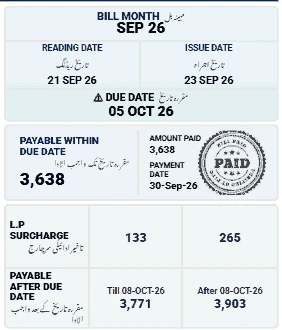
How much is the surcharge?
For many categories, LPS has been around 10% of the bill amount (or of the current month's charges), added once the due date passes. The exact rule depends on your tariff category and current DISCO and NEPRA rules. The bill itself shows the after-due-date amount, which already includes the surcharge.
Example
If your bill is Rs 8,000 within the due date and the surcharge is 10%, the amount after the due date would be about Rs 8,800. Paying one day late costs you about Rs 800.
What happens if you don't pay at all?
- The unpaid amount appears as arrears on the next bill.
- After a certain period of non-payment, the DISCO can issue a disconnection notice and disconnect supply.
- Reconnection requires paying the dues and possibly reconnection fees.
Ways to avoid LPS
- Pay early using banking apps, JazzCash or Easypaisa — payment is usually reflected within a day or two.
- Check your bill online when the paper bill is late; the due date applies whether or not you received the paper copy.
- Set a reminder a few days before the usual due date.
- Save the reference number in your banking app for quick payment.
If the bill arrived late
Late delivery of a paper bill is not usually accepted as a reason to waive the surcharge, because the bill is available online. However, if the bill was issued late by the DISCO itself (for example, issue date very close to due date), you can request the sub-division to extend the due date or waive the surcharge.
Installments for large bills
If a bill is too large to pay at once — for example after a detection or a very high summer bill — you can apply at the sub-division for installments. Approved installments are shown on later bills.
Disputed bills
If you dispute a bill, submit a written complaint before the due date. Ask whether you should pay the undisputed portion to avoid LPS while the complaint is reviewed.