An electricity bill from a Pakistani DISCO packs a lot of information onto one page. Once you know where to look, you can check it in a few minutes. This guide walks through the main sections in the order you'll usually find them.
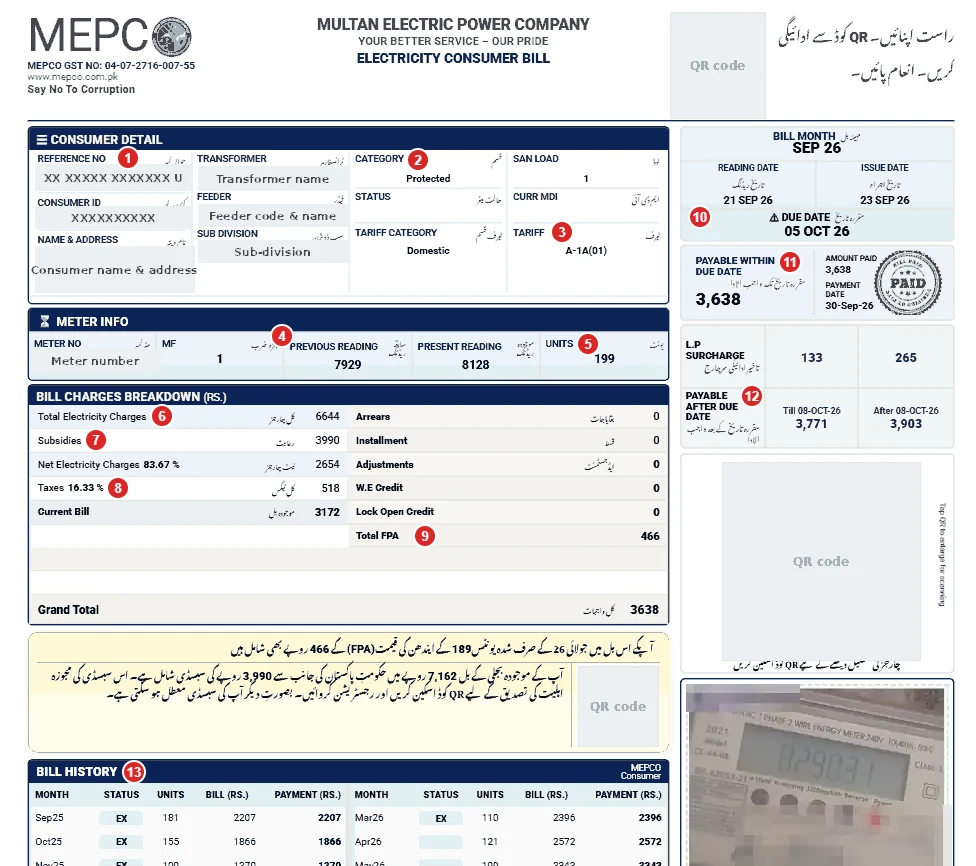
What each number on the bill means
- Reference number — 14 digits used to check and pay the bill online.
- Category — "Protected" means 200 units or less in each of the last six months.
- Tariff — A-1A means domestic (residential) supply.
- Previous and present readings — the meter readings at the start and end of the month.
- Units — present minus previous reading (here 199 units).
- Total electricity charges — units × the applicable tariff.
- Subsidies — the government's share of the cost for eligible consumers.
- Taxes — mainly GST.
- Total FPA — the fuel price adjustment for an earlier month.
- Due date — pay by this date to avoid a surcharge.
- Payable within due date — the amount you pay on time.
- Late-payment surcharge — the extra amount after the due date.
- Bill history — 12 months of units and payments.
1. Consumer and connection details
- Reference number (14 digits): used for online bills, payments and complaints.
- Consumer ID, name and address.
- Tariff code: e.g. A-1 residential, A-2 commercial, B industrial, D agricultural.
- Sanctioned load (kW) and meter number.
- Feeder name and sub-division.
2. Dates
- Reading date — when the meter was read.
- Issue date — when the bill was generated.
- Due date — the last day to pay without surcharge.
3. Meter readings and units
- Previous and present readings.
- Multiplying factor (for some meters).
- Units consumed — the basis of your bill.
- Separate peak/off-peak units for TOU meters, and import/export units for solar meters.
4. Consumption history
A 12-month table of units and amounts. Use it to spot unusual spikes and to check whether you have stayed under 200 units for six months (protected status).
5. DISCO charges
- Cost of electricity: units × tariff rate(s).
- Fixed charges (for some categories).
- FPA (Fuel Price Adjustment) and QTA (Quarterly Tariff Adjustment).
6. Government charges
- GST on taxable electricity value.
- Income tax, further tax, extra tax — mainly for commercial/industrial consumers.
- Electricity duty and PTV fee were removed from bills in 2025.
7. Arrears and adjustments
- Arrears (unpaid previous amounts).
- Installments and deferred amounts.
- Any credit or correction.
8. Totals
- Payable within due date.
- Late payment surcharge and payable after due date.
A quick 5-step check
- Is the present reading the same as on your meter?
- Are units in line with last year's same month?
- Is the tariff correct for your use?
- Are previous payments credited (no wrong arrears)?
- Do FPA/QTA match the announced rates?
If all five look right, your bill is most likely correct. If not, take the bill, a meter photo and your CNIC to the sub-division.