Taxes and government charges can make up a large share of an electricity bill in Pakistan. Some apply to every consumer; others apply only to shops, factories or people who are not tax filers. Two long-standing charges — electricity duty and the PTV fee — were removed from bills in 2025. This guide brings all of them together in one place.
Tax rules change through federal budgets, FBR notifications and government decisions. Use this as an overview and confirm details with official sources.

Quick summary
- GST (sales tax): applies to almost all consumers, commonly at 18% of the taxable value.
- Income tax: mainly commercial and industrial bills above set thresholds; adjustable for filers.
- Further tax: extra sales tax for consumers not registered for sales tax (mainly businesses).
- Extra tax: extra sales tax for certain commercial consumers not on the Active Taxpayer List.
- Electricity duty: removed from bill collection from July 1, 2025.
- PTV fee: removed from electricity bills in 2025.
1. GST (General Sales Tax)
GST is a federal tax charged on the taxable value of electricity — the cost of electricity, fixed charges and adjustments such as FPA and QTA, according to current rules. The standard rate is 18%. Lifeline and some very low-consumption categories have received special treatment in particular decisions.
Example: if the taxable amount is Rs 10,000, GST at 18% is about Rs 1,800.
Read our detailed guide: GST on Electricity Bills in Pakistan Explained.
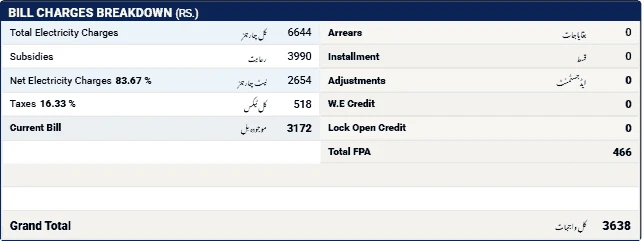
2. Income tax
DISCOs collect advance income tax on behalf of the FBR from commercial and industrial bills above thresholds set in the income tax law. Non-filers can face higher rates. For filers, this tax can usually be adjusted in the annual return, so keep your bills.
Read: Income Tax on Electricity Bills Explained.
3. Further tax and extra tax
These are additional sales taxes, not income tax:
- Further tax applies to consumers who are not registered for sales tax.
- Extra tax applies to certain commercial consumers who are not on the FBR's Active Taxpayer List, depending on the bill amount.
Businesses can avoid them by registering and filing, and by making sure their NTN/STRN is linked to the electricity connection.
4. Electricity duty (removed)
Electricity duty was a provincial levy collected through bills. The federal government stopped collecting it through electricity bills from July 1, 2025, asking provinces to use other methods.
Read: Electricity Duty in Pakistan: What ED Was and Why It Was Removed.
5. PTV fee (removed)
The Rs 35 monthly PTV licence fee was removed from electricity bills in 2025, and the government approved a separate subsidy for PTV.
Read: TV Fee on Electricity Bills: Why the PTV Fee Was Removed.
Charges that are not taxes
Some lines look like taxes but are part of the electricity price:
- Fixed charges (introduced for households in 2026 tariff rebasing, according to reports)
- FPA — Fuel Price Adjustment
- QTA — Quarterly Tariff Adjustment
- Late payment surcharge — a penalty, not a tax
Example: residential vs commercial bill
Residential (non-protected), 300 units: cost of electricity + fixed charge + FPA/QTA, then GST. No income tax in most cases.
Shop (A-2), 300 units, non-filer: cost of electricity + fixed charges + FPA/QTA, then GST, income tax, and possibly further and extra tax. The same units can cost significantly more.
How to reduce taxes on your bill
- Use fewer units — GST is a percentage of the taxable amount.
- Businesses: become a filer and appear on the Active Taxpayer List.
- Register for sales tax if required, and link your registration to your connection.
- Keep bills to claim income tax adjustments.
If you think a tax is wrong
Compare your bill with current rules and your filer status. If a removed charge (electricity duty or PTV fee) still appears on a new bill, or you are charged non-filer taxes despite being on the ATL, submit a written complaint at your DISCO sub-division with proof.