Every electricity bill issued by Pakistan's government-owned distribution companies (DISCOs) carries a 14-digit reference number. It is the single most important number on the bill: you need it to view a duplicate bill online, pay through a banking app, register a complaint, or apply for any change to your connection.

Where to find it
The reference number is printed near the top of the bill, usually labelled "Reference No". It is often shown in groups — for example two digits, five digits and seven digits — and sometimes followed by a letter such as U (urban) or R (rural). When using it online or in a banking app, enter only the 14 digits, without spaces or the letter.
What the parts of the number mean
The structure has a practical purpose:
- First two digits: the billing batch, which determines the reading and billing cycle.
- Next five digits: the sub-division code, which tells the company which office and area your connection belongs to.
- Last seven digits: your individual account within that sub-division.
You do not need to decode the number to use it, but knowing that the middle section identifies your sub-division helps when you visit an office or call 118.
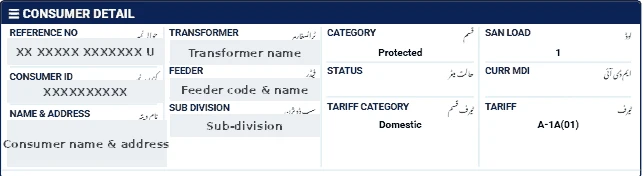
Reference number vs other numbers on the bill
Your bill also shows a customer ID (consumer number), meter number and sometimes a tariff code. These are different. Online portals and banking apps ask for the reference number, not the customer ID. Read our article on reference number vs consumer ID for details.
How to use it to check your bill
- Open our bill checker.
- Select your company (LESCO, MEPCO, FESCO, IESCO, GEPCO, PESCO, HESCO, SEPCO, QESCO, TESCO or HAZECO).
- Enter the 14 digits and click Check Official Bill.
- The official PITC page shows your bill.
Lost your bill and don't know the number?
- Look for an old bill, a payment receipt or an SMS from your bank — many receipts show the reference number.
- Ask your landlord if you rent the property.
- Visit your DISCO sub-division with your CNIC and address; staff can find the number for you.
Keep it private but not secret
The reference number is not a password, and anyone who has it can view the bill amount and address. Avoid posting full bill images publicly on social media. Never share your CNIC or banking details with anyone claiming they need them "to check" your bill.